In this article
"Do I need a website, or just a landing page?" It's one of the most common questions small business owners ask. The answer depends on what you're trying to achieve, because landing pages and websites are designed for very different jobs.
What is a website?
A website is your business's complete online home. It usually includes several pages, such as:
- Home
- About
- Individual service pages
- Location pages
- Gallery or portfolio
- Blog
- Contact
A website helps people explore: learn about your business, compare services, read reviews and decide whether to trust you. It's also how you rank on Google for a range of searches.
What is a landing page?
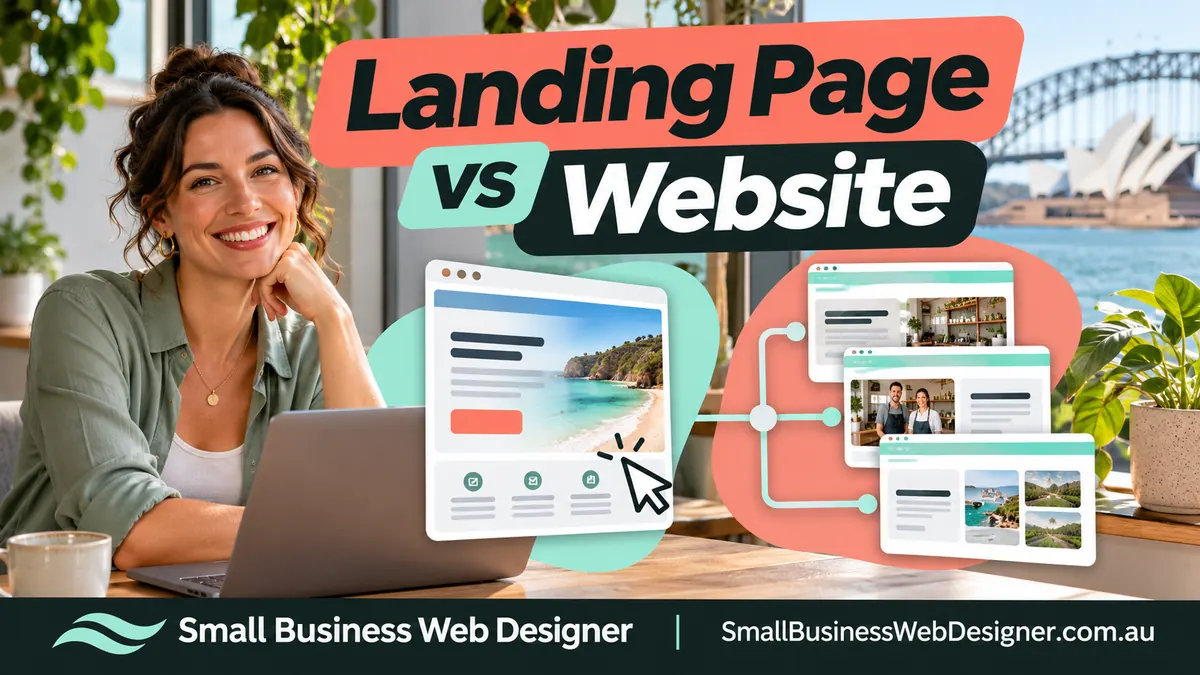
A landing page is a single, standalone page with one goal, such as:
- getting a quote request
- booking a consultation
- collecting an email for a free guide
- selling one product or offer
Landing pages remove distractions: usually no main menu, no links to other pages, just a focused message and a clear call to action. They're typically used as the destination for Google Ads, Facebook and Instagram ads, email campaigns or QR codes.
Landing page vs website: key differences
| Landing page | Website | |
|---|---|---|
| Number of pages | One | Several to hundreds |
| Goal | One specific action | Inform, build trust, rank, convert |
| Navigation | Minimal or none | Full menu |
| Main traffic source | Ads, email, social | Google search, direct, referrals |
| SEO potential | Limited (one topic) | Strong (many keywords) |
| Build time | Days | Weeks |
| Typical cost | $500 – $2,000 | $1,000 – $6,000+ |
| Best for | Campaigns and offers | Long-term presence |
When a landing page is the right choice
Choose a landing page when you:
- Run paid ads. Sending ad traffic to a focused landing page almost always converts better than sending it to your homepage, because the message matches the ad exactly.
- Promote a single offer. A seasonal special, a new product or an event.
- Want to test an idea quickly. Validate demand before building a full website.
- Collect leads. For example, a free quote form, consultation booking or downloadable guide.
- Launch fast. A landing page can be live in days.
When you need a full website
Choose a full website when you:
- Want to rank on Google for multiple services and locations.
- Offer several services that each need explaining.
- Need to build trust with an About page, portfolio, reviews and FAQs.
- Sell multiple products online.
- Want a long-term asset that grows in value over time.
For most established small businesses, a website is essential. Customers expect to be able to look you up, and Google needs multiple pages to understand everything you offer.
Why many businesses use both
The most effective setup for many small businesses is a website plus dedicated landing pages for campaigns:
- The website brings in organic search traffic and builds credibility.
- Landing pages convert paid traffic and specific campaigns at a higher rate.
For example, a Melbourne air conditioning company might have a full website ranking for "air conditioning installation Melbourne", plus a landing page for a winter heating campaign on Google Ads. Each does the job it's best at.
Landing pages can live on your main domain, such as yourbusiness.com.au/winter-special/, so they benefit from your website's reputation.
What makes a high-converting landing page?
If you do create a landing page, make sure it includes:
- A headline that matches the ad or link people clicked.
- A clear, specific offer: what they get and why it matters.
- Benefits, not just features: how your offer helps them.
- Social proof: reviews, logos, results or guarantees.
- One clear call to action, repeated down the page.
- A short form: ask only for what you truly need.
- Fast loading, especially on mobile.
- Answers to common objections, like price, time and risk.
- Conversion tracking, so you know exactly which ads produce leads.
A simple decision guide
- Just starting out and running ads? Start with a landing page.
- Established business that wants Google traffic? Get a full website.
- Running ads AND want organic growth? Use both.
- Promoting a short-term offer? Landing page.
- Many services or locations? Website.
The bottom line
A website is your long-term home online, built to inform, build trust and rank on Google. A landing page is a focused tool built to convert one specific audience into one specific action. Most growing small businesses benefit from both.
We design landing pages from $499 and SEO-ready small business websites from $999. Not sure which you need? Ask us and we'll recommend the right option for your goals and budget.
Frequently asked questions
Can a landing page replace a website?
For a very new business, a single strong landing page can work as a starting point. But a landing page usually can't rank for many different searches or build the same level of trust as a full website, so most growing businesses eventually need both.
Do landing pages help SEO?
Landing pages are mainly designed for conversions from paid traffic, email or social media. A well-built landing page can rank for a focused keyword, but a full website with multiple service and location pages is far more effective for SEO.
How much does a landing page cost?
In Australia, professionally designed landing pages typically cost a few hundred to a few thousand dollars. Our single landing page package is $499 inc. GST, or $799 with conversion tracking and an A/B test variant.

We've been designing SEO-ready websites, logos and SEO campaigns for Australian small businesses since 2019. Read our editorial policy or learn more about us. Questions about this article? Get in touch.